Freeze-Thaw Concrete Damage in Flagstaff: What It Actually Costs to Fix (2026 Guide)
If you've searched for concrete repair cost guides written for Arizona, most of what you'll find assumes a warm, dry climate where the only enemy is soil movement — expansive clay, caliche, monsoon erosion. That's accurate for Phoenix and Tucson. It's mostly wrong for Flagstaff.
Flagstaff sits at roughly 6,900 to 7,000 feet, and according to NOAA's 1991-2020 climate normals for the Flagstaff Pulliam Airport station, the area averages around 206 days a year at or below 32°F, with average annual snowfall of 90.1 inches. That's a genuine, sustained winter freeze-thaw climate sitting inside a state most people associate with cactus and heat advisories. It's also the reason concrete in Flagstaff cracks, flakes, and settles differently than concrete two hours south — and why a cost guide written for desert Arizona doesn't actually apply here.
This guide breaks down what freeze-thaw concrete damage actually costs to repair, organized by the type of damage you're dealing with, and explains why the timing of a repair matters more in Flagstaff's climate than almost anywhere else in the state. Every number here is a general industry range, not a quote for your specific property — no published pricing study covers the Flagstaff market specifically, so we're citing national cost-guide averages and flagging them as such. A free on-site inspection is the only way to get a firm number for your actual damage.
How freeze-thaw damage actually happens
Concrete isn't solid all the way through — it's full of microscopic capillary pores, and those pores can hold water. When that water freezes, it expands by roughly 9% in volume. That expansion generates real hydraulic pressure inside the concrete, as growing ice crystals push unfrozen water ahead of them through the pore structure. Do that once, and a slab is fine. Do it 200 times over a winter, which is well within what local contractors describe happening at this elevation given how many days swing across the freeze point, and the cumulative pressure starts to win.
Modern concrete has a defense against this: air entrainment. Properly air-entrained concrete contains a network of microscopic air bubbles, deliberately engineered so that no capillary pore sits more than a few thousandths of an inch from the nearest air pocket. Those air pockets act as pressure-relief valves — when ice tries to expand, it has somewhere nearby to push into instead of fracturing the surrounding concrete. Older slabs, and concrete poured without careful attention to air-entrainment ratios, don't have that protection built in, which is a huge part of why so much of Flagstaff's older concrete infrastructure is cracking and flaking while more recently poured, properly air-entrained work is holding up.
Saturation matters just as much as the freeze itself. Concrete that stays relatively dry through a cold snap takes very little damage no matter how many times the temperature crosses freezing. Concrete that's saturated — because of standing snowmelt, poor drainage, or a shaded spot that never fully dries out between storms — is where damage accelerates fastest, because there's simply more water available in the pore structure to freeze and expand. This is why freeze-thaw damage on a given property is so often concentrated in the exact same spot, winter after winter: the low corner, the shaded side of the house, the area near a downspout.
The three failure modes you'll actually see
Freeze-thaw damage doesn't look like one thing. It shows up as three related but distinct problems, and knowing which one you're looking at changes both the fix and the cost.
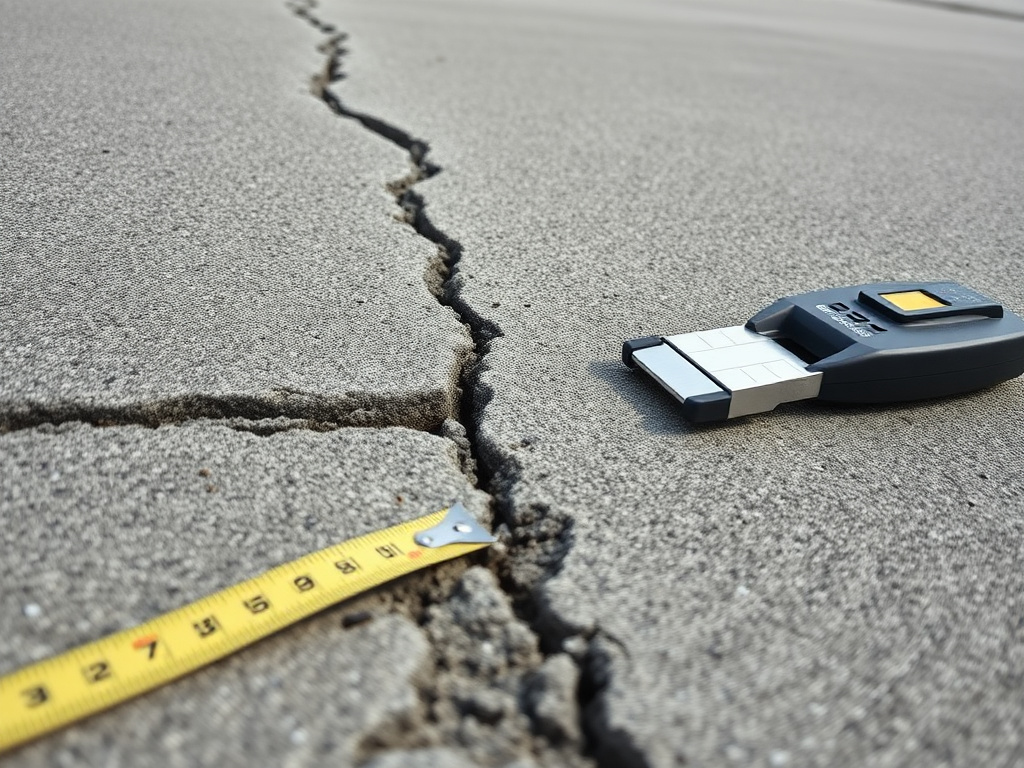
- Cracking — a fracture through the body of the concrete, ranging from a hairline surface crack to a structural crack with visible displacement between the two sides.
- Spalling and scaling — the surface layer breaking apart. Scaling is thinner and more widespread, often concentrated where water sits longest or where de-icing salt has been used repeatedly. Spalling is deeper, sometimes exposing the aggregate or rebar underneath.
- Settlement and heaving — the slab itself sinking, tilting, or lifting unevenly, often tied to Flagstaff's cinder-over-clay soil profile shifting differently than a simple gravel base would.
What crack repair costs
Crack repair pricing depends heavily on whether you're dealing with a cosmetic crack or a structural one. General industry ranges put crack repair around $150 to $500 per crack, with flexible polyurethane or silicone sealing — the right call for non-structural cracks that will keep moving slightly with the seasons — typically landing in the $150 to $300 per crack range. Structural cracks, especially ones with visible vertical displacement, usually call for epoxy injection, which bonds the two sides of the crack back together and restores real structural continuity rather than just sealing the surface — that's typically $250 to $500 per crack. Driveway crack sealing is sometimes priced per linear foot instead, commonly in the $0.50 to $3 per linear foot range depending on method and access.
The number that matters most here isn't the price per crack — it's the price per crack this year versus the price per crack after two or three more winters of freeze cycling have widened it, forced more water in, and turned a simple sealant job into an epoxy injection job, or worse, spread into surrounding spalling that needs its own separate repair.
What spalling and scaling repair costs
Spalling and scaling repair costs are driven primarily by total affected square footage and how deep the damage goes. A small area of surface scaling in a shaded corner is a far more contained repair than scaling spread across an entire driveway, or spalling deep enough to have exposed rebar, which needs a more thorough structural assessment before any resurfacing happens. Because scope varies so widely between a single popout and widespread surface deterioration, spalling repair doesn't have a single clean per-square-foot number the way crack repair or slab lifting does — it's genuinely a case where an on-site look at the actual damage is the only honest way to price it.
One detail worth understanding if you're budgeting for spalling repair: addressing the drainage or saturation issue that's feeding the damage is often part of doing the job right. Resurfacing a spalled section without correcting whatever's kept it wetter than the rest of the slab — poor grading, a downspout dumping water right at that spot — tends to mean the same section spalls again within a few winters.
What slab leveling costs
Slab leveling has two established methods with meaningfully different pricing. Polyurethane foam lifting, injected through small entry holes and curing in about 15 minutes, typically runs $5 to $25 per square foot, or roughly $800 to $2,500 per section. Traditional mudjacking, which pumps a cement-based slurry underneath the slab through larger holes and takes hours rather than minutes to cure, typically runs $3 to $6 per square foot, or roughly $500 to $1,500 per section.
The cost difference between the two methods is real, but so is the practical difference. Mudjacking slurry is significantly heavier than polyurethane foam, which matters on ground that's already struggling to support the slab evenly — a common situation in Flagstaff given the area's cinder-over-clay soil profile. Foam's faster cure time also means less disruption; a driveway lifted with polyurethane foam in the morning can often be back in use the same day, while mudjacking needs a longer cure window before it's ready for vehicle loads.
Repair vs. replacement: the economics
The instinct when concrete looks bad — cracked, flaking, uneven — is often to assume it needs full replacement. In most cases where the underlying slab is still structurally sound, that instinct is wrong, and expensive. Crack repair, resurfacing, and slab leveling all cost a fraction of demolition and a new pour, and they address the same visible problems as long as the damage hasn't progressed past the point where the existing concrete can be restored.
Replacement genuinely becomes the better option when damage is extensive across the whole slab, when spalling has exposed and corroded rebar across a wide area, or when a slab has cracked through its full depth in multiple places rather than showing isolated cracks. An honest on-site inspection is the only reliable way to know which category your concrete falls into — and a contractor who defaults to "just replace it" for a slab that could have been repaired for a fraction of the cost isn't doing you any favors.
Why timing changes the number more here than elsewhere
In a climate that doesn't freeze, a hairline crack can sit for years without changing much. In Flagstaff, with an average of around 206 freeze days a year, that same crack is exposed to repeated freeze-expand cycling every single winter it goes unaddressed. A crack that would cost $150 to seal in October can realistically need $400-$500 epoxy injection by the following spring if it's been left to widen through a full winter — and if water finds its way in far enough, it can start contributing to spalling around the crack too, which is its own separate repair cost.
This is the single biggest difference between budgeting for concrete repair in Flagstaff versus budgeting for it in Phoenix. Soil-movement cracking in the low desert tends to progress gradually over years. Freeze-thaw cracking in Flagstaff can visibly worsen within a single winter season. Catching damage early — ideally before the first hard freeze of a given year, or as soon as you notice a new crack or a flaking patch — is genuinely the highest-leverage thing a homeowner here can do to control the total repair cost.
The de-icing salt factor, and what actually causes it
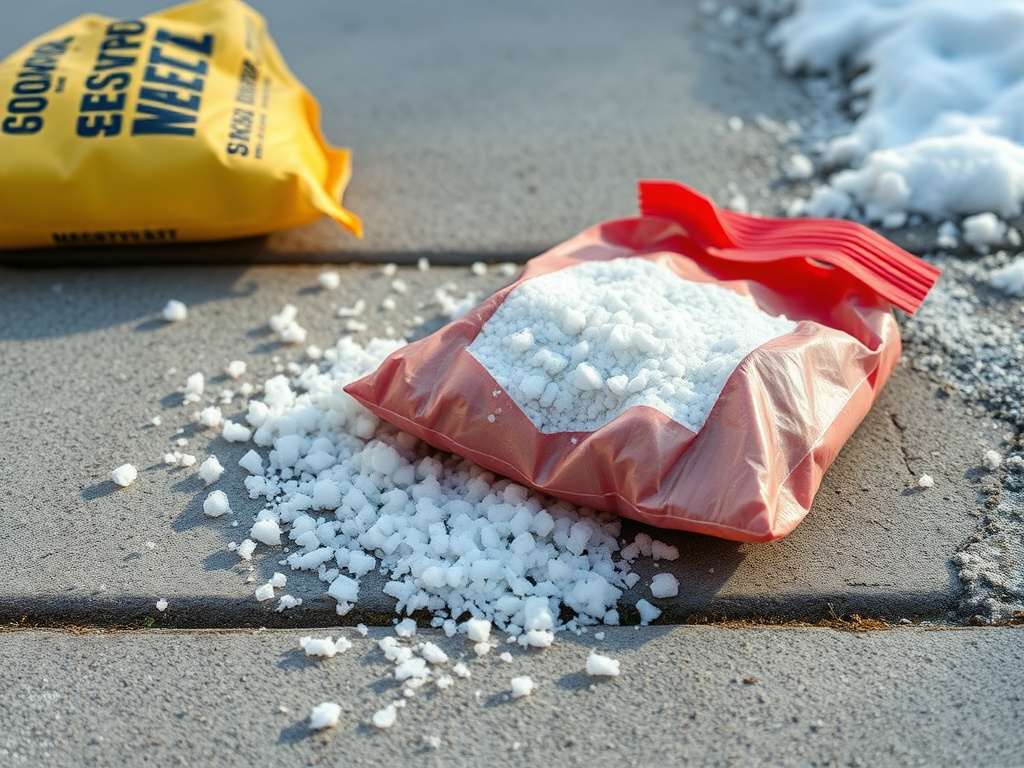
It's worth clearing up a common assumption: road salt is not the primary driver of concrete scaling for most Flagstaff properties. The City of Flagstaff switched away from chemical de-icer on city streets back in 2013, moving to volcanic cinders specifically because the chemical product was found to be harming roadside ponderosa pines — Flagstaff plows its streets with cinders, not salt. ADOT does still apply chemical de-icer on state highways running through town, including Route 66, Milton Road, and Fort Valley Road, so there's some exposure along those specific corridors.
For most homeowners, the bigger factor in surface scaling is the bagged ice-melt product applied to their own driveway, walkway, or front steps. Repeated use of de-icing salt on a private surface keeps the concrete wetter for longer through each freeze cycle — exactly the saturation condition that accelerates scaling. If you've noticed your driveway surface getting rougher and flakier year over year and you've been salting it regularly, that's very likely a meaningful contributor, and it's worth weighing against the cost of the resurfacing repair it eventually leads to.
Budgeting: repair now vs. a bigger project later
It helps to think of freeze-thaw concrete repair the way you'd think of any other home-maintenance category where small, early fixes prevent large, expensive ones — a roof leak, a slow plumbing drip, a foundation hairline crack. None of those get cheaper by waiting, and freeze-thaw damage is arguably more time-sensitive than most, because the damage mechanism is tied directly to a predictable seasonal cycle rather than a slow, steady process. A homeowner who has a crack sealed or a scaled patch resurfaced in late summer or early fall, ahead of the first hard freeze, is spending money on a small, contained repair. A homeowner who waits until spring to deal with the same issue is often paying for a winter's worth of additional damage on top of the original problem.
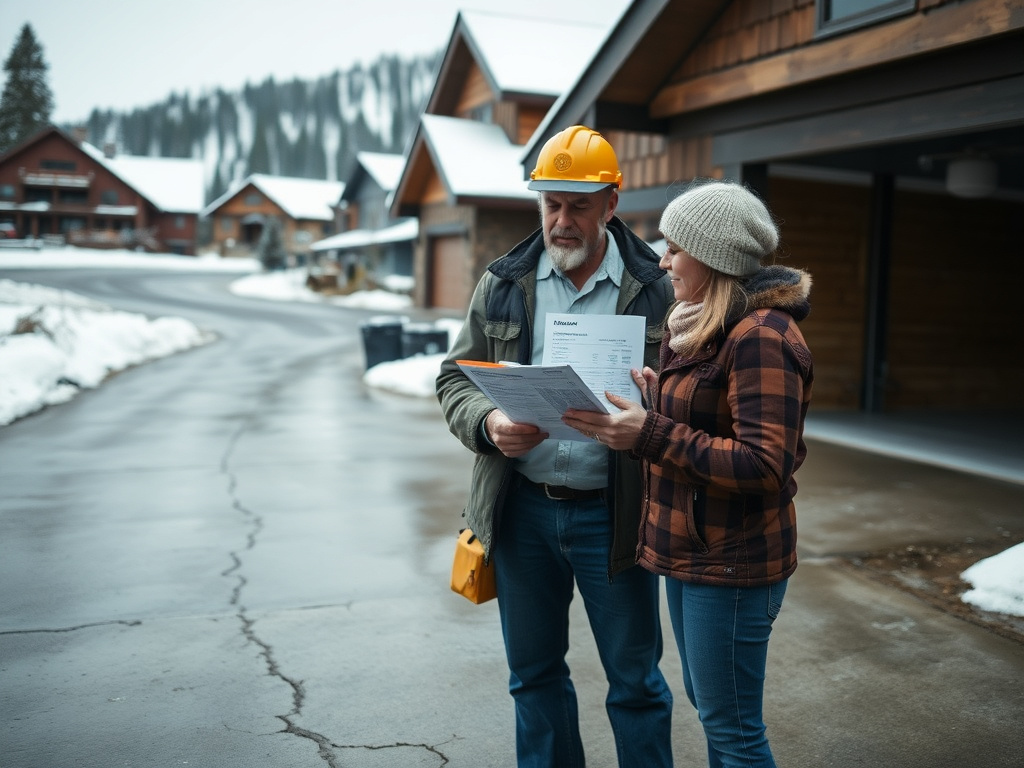
That's also why we lead with a free on-site inspection rather than a phone-quote guess. Two driveways with what looks like the same size crack can have very different underlying conditions — one might be a clean, isolated crack in otherwise sound, well-drained concrete, while the other might be sitting on soil that's already shifting, with water pooling nearby every time it snows. The first is a straightforward, inexpensive repair. The second might need drainage correction alongside the crack repair to actually hold. You can't tell the difference from a photo or a phone description, which is exactly why an honest inspection — not a generic price list — is how we approach every estimate.
How elevation across Northern Arizona changes the math
Not every part of our service area experiences freeze-thaw cycling with equal intensity, and that genuinely affects both how fast damage develops and how urgently a repair is worth scheduling. Flagstaff itself, at roughly 6,900 to 7,000 feet, sees the most sustained cold-season exposure in the region. Williams, about 30 miles west at around 6,700 feet, tracks closely with Flagstaff's climate and sees comparable freeze-thaw stress on driveways and walkways. Munds Park and Kachina Village, forested communities along I-17 south of Flagstaff, sit at similarly high elevation and often add shaded, slow-to-dry lots into the mix — a real factor given how much saturation drives freeze damage.
Prescott and Prescott Valley are a different story. At roughly 5,300-5,400 feet and 5,100 feet respectively, both sit meaningfully lower than Flagstaff, and their freeze-thaw cycling, while real, tends to be less severe. Prescott Valley in particular sees wide day-to-night temperature swings — sources put the annual range near 19°F to 90°F with regular 20-30°F daily swings — which drives its own freeze-thaw cycling even without Flagstaff's snow totals. Prescott's soil is also a different profile entirely: decomposed granite and caliche rather than Flagstaff's volcanic cinder, which changes how cracking and settlement actually present. Sedona sits somewhere in between climatically, still cold enough most winters for real freeze-thaw exposure, with the added factor of heavy year-round tourist traffic through the narrow Oak Creek Canyon corridor adding mechanical wear on top of the thermal cycling.
The practical takeaway: a repair estimate for a Flagstaff driveway and a repair estimate for a Prescott Valley driveway aren't interchangeable, even for what looks like the same size crack. Elevation, soil type, shade, and traffic load all move both the rate of damage and the right repair approach — which is exactly why we assess each property on its own conditions rather than applying one blanket number across the whole region.
Getting an accurate number for your property
Every range in this guide is a general industry figure, not a quote — your specific crack length, the depth of spalling, your slab's soil condition, and how many separate issues you're dealing with at once all move the real number. The only way to get an accurate estimate is a free on-site inspection, where we assess what's actually happening — cracking, spalling, settlement, or some combination — and give you a clear, itemized number before any work starts. Given how much freeze-thaw damage can progress in a single Flagstaff winter, the earlier that inspection happens, the more repair options (and the lower the eventual cost) tend to be on the table.
Frequently asked questions
It depends heavily on the type of damage. General industry ranges put crack repair around $150-$500 per crack, polyurethane foam slab lifting around $5-$25 per square foot, and mudjacking around $3-$6 per square foot. Spalling and scaling repair is priced by affected area and depth of damage, which varies too widely for a single number. A free on-site inspection gives you a firm figure for your specific concrete.
Flagstaff averages around 206 days a year at or below 32°F, according to NOAA climate normals. Every one of those days is a chance for water in a crack or pore to freeze, expand by roughly 9% in volume, and push existing damage a little further. Phoenix rarely sees sustained freezing, so its concrete problems (mostly soil-movement cracking) tend to progress much more gradually over years rather than within a single season.
Repairing damage before or early in freeze season is almost always cheaper than waiting. A crack or spalled patch left through a full Flagstaff winter — with its average of around 206 freeze days — typically gets meaningfully worse, turning a simple sealant repair into a more involved (and more expensive) structural fix.
Ready for a free estimate?
Tell us about your damaged concrete and we'll build a clear, no-pressure estimate.