Slab Leveling & Polyurethane Lifting
A sunken or uneven slab in Flagstaff is usually a repair, not a replacement — polyurethane foam or traditional mudjacking lifts the existing concrete back into place from underneath.
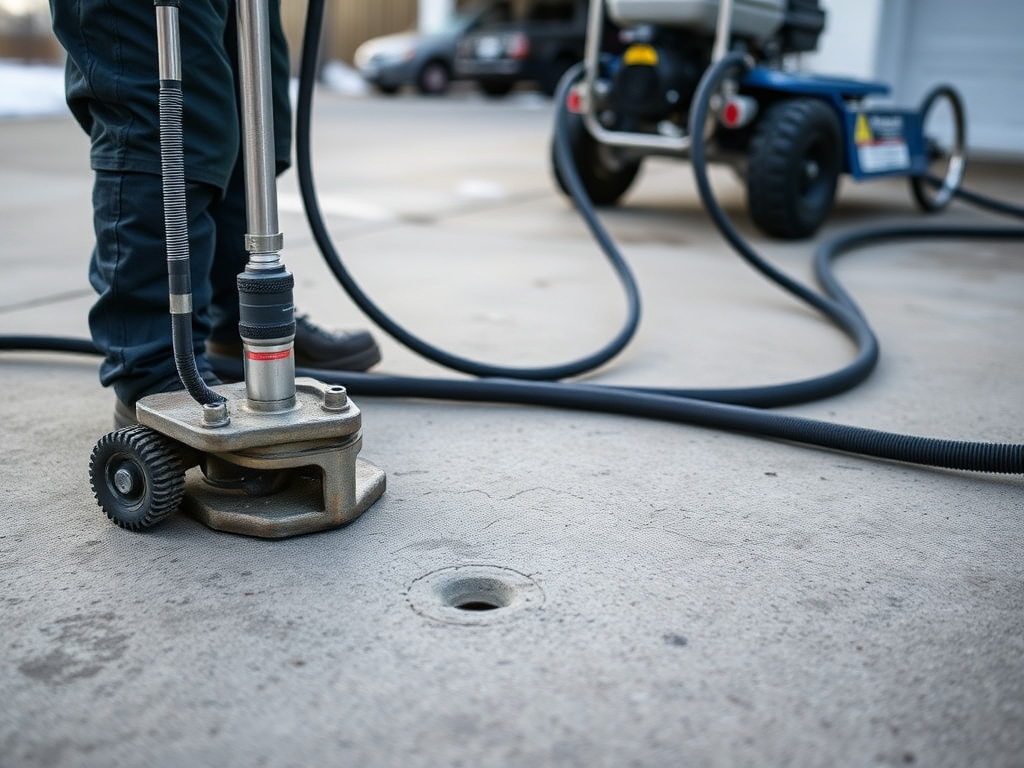
Slabs settle for a mix of reasons — soil compaction under the original pour, erosion from snowmelt and runoff, and in Flagstaff's case, the added complication of a cinder-over-clay soil profile that doesn't always support a slab as evenly as it did on day one. Once a slab sinks even an inch, it creates a trip hazard, sheds water into places it shouldn't, and gets worse over time as water pools at the low point and continues to erode the base beneath it.
Two established methods lift an existing slab back to grade without replacing it. Polyurethane foam lifting injects a dense, expanding foam through small entry holes; it cures in about 15 minutes, weighs a fraction of traditional mudjacking slurry, and offers precise control over how much lift you get. Traditional mudjacking pumps a cement-based slurry underneath the slab through larger holes; it costs less per square foot but takes longer to cure and adds significantly more weight to the soil underneath, which matters on ground that's already marginal. We'll walk through which method fits your specific slab, soil, and budget rather than defaulting to one option.
This is squarely a repair service — we're lifting and leveling concrete that already exists, not pouring new slabs. If your existing driveway, patio, sidewalk, or garage floor has sunk, tilted, or created an uneven transition at a threshold or joint, this is very likely the fix, and it's almost always faster and less disruptive than demolition and a full replacement pour.
Why property owners choose it
- Lifts and levels the concrete you already have instead of a full tear-out and replacement.
- Polyurethane foam cures in about 15 minutes, meaning the surface is usable again the same day.
- Addresses the trip hazard and drainage problems a sunken slab creates before they get worse.
- Matched to Flagstaff's cinder-over-clay soil profile, not a generic desert-AZ leveling approach.
- Meaningfully less disruptive and lower-cost than demolition and a new pour for a slab that's still structurally sound.
Polyurethane foam vs. traditional mudjacking
Polyurethane foam lifting uses a two-part expanding foam injected through small (roughly 5/8-inch) holes. It cures in about 15 minutes, is dramatically lighter than mudjacking slurry, and gives precise, controllable lift. It typically runs higher per square foot than mudjacking, but the speed and precision are often worth it, especially on ground that's already carrying moisture and settlement issues.
Traditional mudjacking pumps a cement-based slurry underneath the slab through larger holes, typically 1-2 inches. It costs less per square foot and has been used successfully for decades, but takes hours rather than minutes to cure and adds considerably more weight underneath the slab than foam does — a real consideration on soil that's already struggling to support the load.
- Polyurethane foam: ~15-minute cure, precise lift, lighter material, higher cost per square foot
- Mudjacking: lower cost per square foot, hours to cure, heavier material, decades-proven method
Why Flagstaff's soil makes leveling more common here
Much of the Flagstaff area sits on volcanic cinder from the San Francisco Volcanic Field, commonly layered over expansive clay beneath it. Cinder alone isn't a strong bearing material, and the clay underneath shrinks and swells with moisture — a combination that, layered with heavy seasonal snowmelt and genuine freeze-thaw cycling, creates more settlement variability than a simple sand or gravel base would. That's a meaningfully different foundation environment than either classic frost-belt states or Arizona's low desert, and it's a big part of why slab leveling is such a common repair call here.
Ideal for
- Driveways, patios, sidewalks, or garage slabs that have visibly sunk or tilted
- Uneven transitions at a doorway threshold, expansion joint, or slab seam
- Slabs that shed water toward a foundation or entryway instead of away from it
- Homeowners who assumed a sunken slab meant a full, costly replacement
What affects the cost
Slab Leveling questions, answered
General industry ranges (no Flagstaff-specific pricing study exists, so treat these as national averages) put polyurethane foam lifting around $5-$25 per square foot or roughly $800-$2,500 per section, and traditional mudjacking around $3-$6 per square foot or roughly $500-$1,500 per section. A free on-site inspection gives you a firm number based on your slab and soil.
It depends on your priorities and soil. Polyurethane foam cures in about 15 minutes, is much lighter, and gives more precise lift control — often the better choice on soil that's already struggling to support the slab. Mudjacking costs less per square foot and has a long track record, but takes hours to cure and adds more weight underneath. We'll recommend the right one for your specific situation during a free inspection.
In most cases where the slab itself is still structurally sound — no major cracking through the body of the concrete, no crumbling edges — lifting is a faster, less disruptive, and less expensive fix than demolition and a new pour. We assess the slab's condition first; if it's too deteriorated to lift successfully, we'll tell you honestly rather than attempt a repair that won't hold.
Slab Leveling done right, by a crew that works this specific climate
Slab Leveling isn't a commodity — the result depends on correctly diagnosing whether you're looking at freeze-thaw damage, soil-movement settlement, or both, and matching the repair to Flagstaff's real winter exposure instead of a warm-climate approach. We assess what your concrete actually needs, address the root cause where we can, and repair to hold through real Northern Arizona winters.
We serve Flagstaff, Doney Park, Fort Valley, Bellemont, Parks, Munds Park, Kachina Village, Williams, Sedona, Prescott, and Prescott Valley. Every job starts with a free, no-pressure on-site estimate.
We also stay in our lane: we repair and restore existing concrete — we don't pour new driveways or handle new-construction flatwork. That focus is deliberate. Diagnosing and fixing damaged concrete correctly is a different skill set than pouring new slabs, and it's the one we've built this company around.
Free inspection
We assess the actual damage and give you a clear, itemized estimate.
Correct diagnosis
We identify whether slab leveling needs a targeted repair or a more involved fix — no upsell.
A repair that holds
Work matched to real Flagstaff winters, not a warm-climate patch job.
Related repair services
Ready for a free slab leveling estimate?
Tell us what's cracked, sunken, spalled, or heaved and we'll put together a clear, no-pressure repair estimate — built for real Flagstaff-area freeze-thaw damage.