Freeze-Thaw Damage Restoration
Flagstaff sits at roughly 6,900 to 7,000 feet, where NOAA climate normals put the city at around 206 days a year at or below 32°F — the mechanism behind almost every concrete failure we see that Phoenix and Tucson contractors rarely encounter.
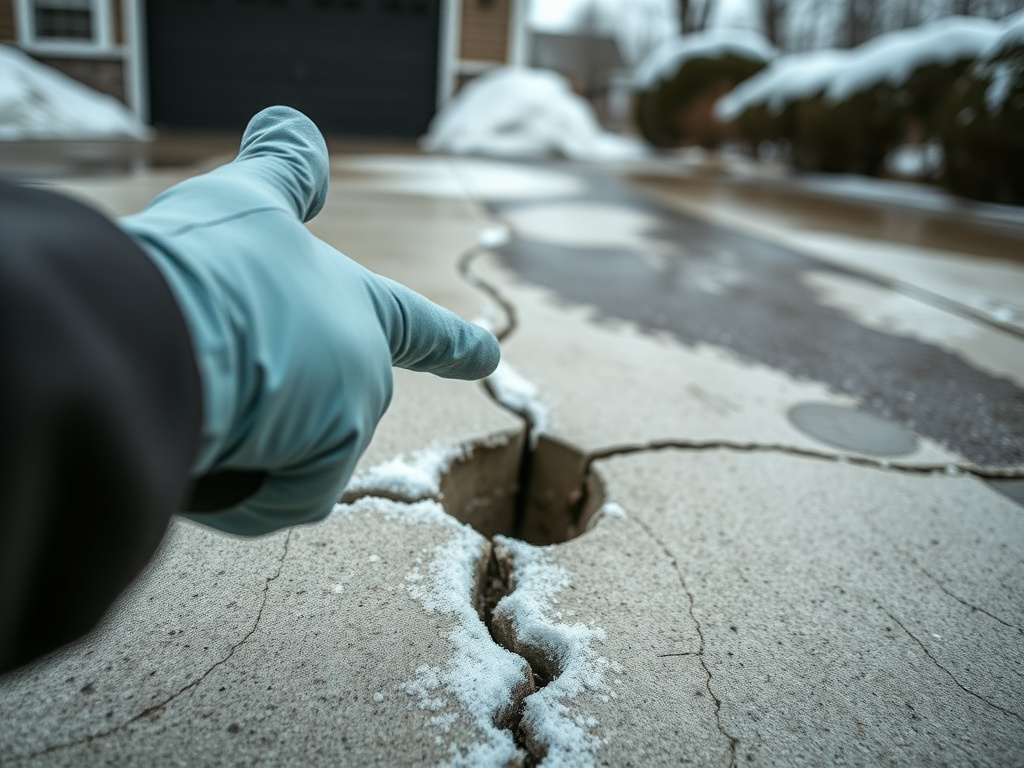
Most of Arizona doesn't freeze. Phoenix, Tucson, and the low desert see concrete problems driven almost entirely by soil movement — expansive clay swelling and shrinking with the monsoon, caliche layers, and flash erosion. Flagstaff and Northern Arizona are different. At roughly 6,900 to 7,000 feet, NOAA's 1991-2020 climate normals for Flagstaff put the area at around 206 days a year at or below freezing, with average annual snowfall of 90.1 inches. That's a genuinely cold, high-elevation climate sitting inside a state most people think of as desert-only.
The damage mechanism is well understood: water works into a slab's capillary pores, and when it freezes it expands by roughly 9% in volume. That expansion generates hydraulic pressure inside the concrete as growing ice crystals push unfrozen water ahead of them. Properly air-entrained concrete has a network of microscopic air bubbles built in specifically to absorb that pressure — engineering guidance calls for no capillary void more than a few thousandths of an inch from the nearest air pocket. Older slabs, DIY pours, and concrete placed before more careful air-entrainment practices became standard often don't have that protection, which is exactly why so much of Flagstaff's aging concrete is cracking, flaking, and heaving while newer, properly air-entrained work holds up.
This is also why saturation matters as much as temperature. Concrete that stays dry through a freeze cycle takes little damage no matter how cold it gets; concrete that's saturated — from snowmelt pooling against a slab, poor drainage, or a shaded spot that never fully dries between storms — is where freeze-thaw damage accelerates fastest. That's the pattern we're called out for again and again: a driveway or walkway that holds water in one spot cracks and spalls there first, winter after winter, while the rest of the slab stays intact.
Why property owners choose it
- Diagnoses freeze-thaw damage correctly instead of treating it like desert-AZ soil-movement cracking — a different mechanism needs a different repair approach.
- Addresses the saturation and drainage issues that concentrate freeze damage in the same spots year after year, not just the visible crack or spall.
- Matches repair materials and methods to Flagstaff's real winter exposure, not a warm-climate product that isn't rated for repeated freeze cycling.
- Restores structural integrity, not just cosmetic patching, so the same section doesn't fail again next winter.
- Local crews who work this specific high-elevation freeze-thaw climate, not a statewide generalist treating every Arizona city the same.
Why Flagstaff concrete fails differently than Phoenix concrete
In the low desert, concrete problems are almost always about what's underneath the slab — expansive clay soils that swell and shrink with moisture, caliche layers that don't compress evenly, and monsoon-driven erosion. Freeze damage barely enters the picture because sustained sub-freezing temperatures are rare.
In Flagstaff, the story is reversed. Yes, Northern Arizona has its own soil complexity — much of the area sits on volcanic cinder from the San Francisco Volcanic Field, a roughly six-million-year-old eruptive field with around 600 cinder cones (Sunset Crater, about 15 miles northeast of the city, is the youngest). Locally, that cinder layer commonly sits over expansive clay beneath it, a combination distinct from both classic frost-belt states and low-desert Arizona. But layered on top of that soil profile is a genuine winter freeze cycle that low-desert Arizona simply doesn't have — and that's usually the dominant factor in what we're repairing.
- Low-desert Arizona: soil-movement cracking, expansive clay, caliche, monsoon erosion
- Flagstaff & Northern Arizona: freeze-thaw cracking and spalling layered on volcanic cinder-over-clay soils
The de-icing detail most contractors get wrong
A lot of freeze-thaw copy assumes road salt is the main culprit behind concrete scaling. That's not quite right here. The City of Flagstaff actually stopped using chemical de-icer on city streets back in 2013, switching to volcanic cinders after the chemical product was found to be harming roadside ponderosa pines — Flagstaff plows with cinders, not salt, on city streets. ADOT still applies chemical de-icer to state highways running through town, like Route 66, Milton Road, and Fort Valley Road, so that exposure exists on some corridors.
The bigger scaling risk for most homeowners is the ice-melt product they put down themselves. Bagged de-icing salt on a private driveway, walkway, or front step keeps the surface wetter for longer through repeated freeze cycles, which is exactly the saturation condition that accelerates scaling — thin surface flaking distinct from a deeper structural crack. If you've been salting your own driveway every winter and noticed the surface getting rougher and flakier, that's very likely why.
Ideal for
- Driveways, walkways, and patios with cracking, flaking, or crumbling that gets visibly worse after winter
- Slabs with standing water or shaded, slow-to-dry spots that show damage concentrated in one area
- Older concrete poured before modern air-entrainment standards were standard practice
- Homeowners who've had a slab "patched" before that failed again the following winter
What affects the cost
Freeze-Thaw Damage Restoration questions, answered
It's the state's clearest freeze-thaw market. Flagstaff sits at roughly 6,900-7,000 feet, where NOAA's climate normals show around 206 days a year at or below 32°F and average annual snowfall of 90.1 inches — genuinely different from Phoenix or Tucson, which almost never see sustained sub-freezing temperatures. Nearby Prescott and Prescott Valley sit at lower elevation (roughly 5,100-5,400 feet) and see real but less severe freeze-thaw cycling than Flagstaff proper.
Freeze-thaw damage tends to concentrate where water sits longest — a shaded corner, a low spot that holds snowmelt, or an area near a downspout — and it often shows surface scaling or flaking alongside cracking, not just a single clean crack line. Soil-movement cracking, more common in low-desert Arizona, tends to follow different patterns tied to slab edges and expansive soil. A free on-site inspection can tell you which you're dealing with.
The City of Flagstaff switched from chemical de-icer to volcanic cinders on city streets in 2013 specifically to protect roadside ponderosa pines, so citywide street-salt exposure is limited. ADOT still uses chemical de-icer on state highways through town. The bigger factor for most homeowners is the bagged ice-melt product applied to their own driveway or walkway, which can accelerate surface scaling over repeated winters.
Freeze-Thaw Damage Restoration done right, by a crew that works this specific climate
Freeze-Thaw Damage Restoration isn't a commodity — the result depends on correctly diagnosing whether you're looking at freeze-thaw damage, soil-movement settlement, or both, and matching the repair to Flagstaff's real winter exposure instead of a warm-climate approach. We assess what your concrete actually needs, address the root cause where we can, and repair to hold through real Northern Arizona winters.
We serve Flagstaff, Doney Park, Fort Valley, Bellemont, Parks, Munds Park, Kachina Village, Williams, Sedona, Prescott, and Prescott Valley. Every job starts with a free, no-pressure on-site estimate.
We also stay in our lane: we repair and restore existing concrete — we don't pour new driveways or handle new-construction flatwork. That focus is deliberate. Diagnosing and fixing damaged concrete correctly is a different skill set than pouring new slabs, and it's the one we've built this company around.
Free inspection
We assess the actual damage and give you a clear, itemized estimate.
Correct diagnosis
We identify whether freeze-thaw damage restoration needs a targeted repair or a more involved fix — no upsell.
A repair that holds
Work matched to real Flagstaff winters, not a warm-climate patch job.
Related repair services
Ready for a free freeze-thaw damage restoration estimate?
Tell us what's cracked, sunken, spalled, or heaved and we'll put together a clear, no-pressure repair estimate — built for real Flagstaff-area freeze-thaw damage.